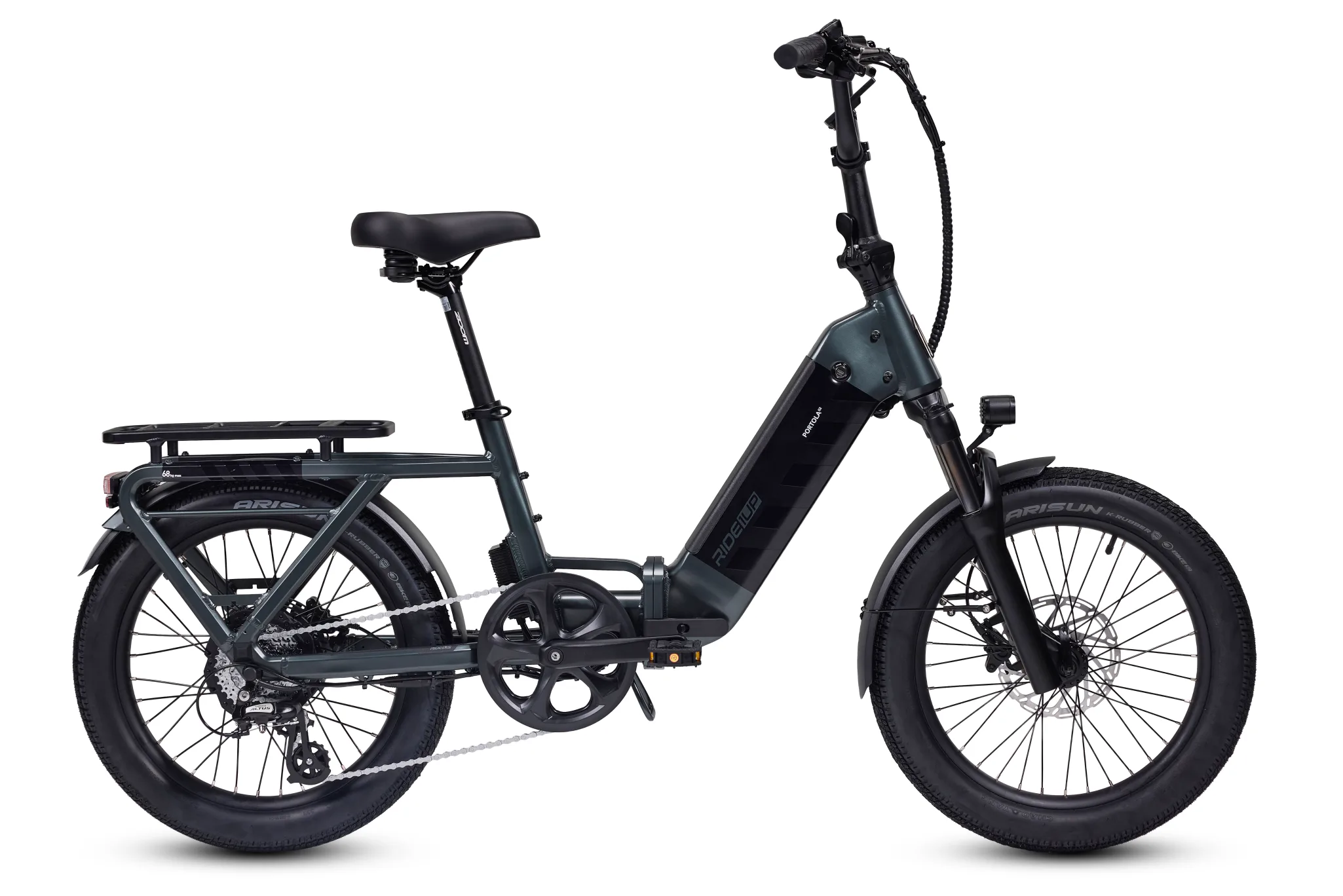
Heybike · Folding
Heybike Ranger S 2.0: real range, hills and charging
A 180 lb rider on the Heybike Ranger S 2.0 at 16 mph with relaxed pedaling over rolling hills (±2%) on pavement can expect about 41 miles per charge (33–49 mi), using 15.1 Wh per mile. The brand claims up to 55 miles. That is about 75% of the claim. On throttle only over hills it drops to about 28 miles.

692
Wh battery
750
W motor
28
mph max
Price checked 2026-10-20. We may earn a commission.
How far does the Heybike Ranger S 2.0 go for your weight?
Miles per full charge on a new battery at 70°F on pavement, no wind. Each number is the middle of a ±20% band. Heybike claims up to 55 miles (under optimal conditions).
| Rider weight | Easy 12 mph | Everyday 16 mph | Fast 20 mph | Throttle, hills |
|---|---|---|---|---|
| 150 lb | 67 mi (53–80) | 44 mi (35–52) | 31 mi (24–37) | 31 mi (25–37) |
| 200 lb | 58 mi (47–70) | 40 mi (32–48) | 29 mi (23–34) | 26 mi (21–32) |
| 250 lb | 52 mi (42–62) | 35 mi (28–42) | 27 mi (22–32) | 23 mi (18–28) |
| 300 lb | 47 mi (37–56) | 32 mi (25–38) | 26 mi (20–31) | 21 mi (16–25) |
- Easy 12 mph: 12 mph, relaxed pedaling, flat
- Everyday 16 mph: 16 mph, relaxed pedaling, rolling hills
- Fast 20 mph: 20 mph, relaxed pedaling, rolling hills
- Throttle, hills: 15 mph, no pedaling, hilly
Can the Heybike Ranger S 2.0 climb hills?
Highest steady speed on each grade, motor at its 1,400 W peak, limited by its 80 Nm of torque. A 10% grade is a steep city street; 15% is a hard hill.
| Rider | 5% grade | 10% grade | 15% grade |
|---|---|---|---|
| 180 lb, throttle | 23 mph | 15 mph | 11 mph |
| 180 lb, pedaling | 24 mph | 16 mph | 12 mph |
| 250 lb, throttle | 21 mph | 13 mph | 9 mph |
| 250 lb, pedaling | 22 mph | 13 mph | 10 mph |
Steepest grade at 8 mph (180 lb): 23% on throttle, 25% with moderate pedaling. Peak power lasts for short hills; on long climbs motors fall back toward their 750 W nominal rating.
Charging time and cost
Empty to full (2 A)
6 h 23 min
With a 5 A charger
3 h 9 min
Cost per full charge
$0.15
Cost per mile
0.33¢
US average residential electricity, 18.31¢/kWh (EIA, July 2026), 85% charger efficiency. Charge time: constant current to ~85%, then about an hour of top-off.
Range in cold weather
70°F
41
mi · 100% cap.
50°F
38
mi · 94% cap.
32°F
33
mi · 85% cap.
20°F
29
mi · 75% cap.
Everyday scenario, 180 lb rider. Capacity loss is temporary; store and charge the battery indoors and never charge it below freezing.
Simulate your own ride on the Ranger S 2.0
Heybike Ranger S 2.0 specs
From the Heybike product page, checked 2026-10-20. est. marks values Heybike doesn't confirm.
- Price
- $999
- Class
- Class 3, throttle
- Top assisted speed
- 28 mph
- Battery
- 692 Wh (48 V × 14.4 Ah), removable
- Motor
- 750 W nominal, 1,400 W peak, rear hub
- Torque
- 80 Nm
- Pedal sensor
- Cadence
- Claimed range
- Up to 55 mi (Under optimal conditions)
- Weight
- Not published (we assume 66 lb) est.
- Max load
- Not published est.
- Wheels & tires
- 20" × 4"
- Frame
- Folding step-thru
- Charger
- Not published (we assume 2 A) est.
- Safety certification
- UL 2849
Replaces or follows: Heybike Ranger.
Common questions
What is the weight limit of the Heybike Ranger S 2.0?
Heybike doesn't publish a maximum load for the Ranger S 2.0.
Can the Heybike Ranger S 2.0 climb steep hills?
On throttle alone, with a 180 lb rider, it can hold 8 mph up a grade of about 23% (our estimate from its 1400 W peak power and 80 Nm). With moderate pedaling, about 25%. On a 10% hill it holds about 15 mph on throttle.
How long does the Heybike Ranger S 2.0 take to charge?
About 6 h 23 min from empty with the 2 A charger, or about 3 h 9 min with a 5 A fast charger. A full charge costs about $0.15 at the US average of 18.31¢/kWh, or 0.33¢ per mile.
Is the Heybike Ranger S 2.0 a Class 2 or Class 3 e-bike?
Heybike lists it as Class 3, with a top assisted speed of 28 mph and a throttle. Class 3 speeds (up to 28 mph) are limited to pedal assist; on throttle, Class 2 rules cap it at 20 mph.
Which hitch racks fit the Ranger S 2.0?
Heybike doesn't publish the bike's weight, so we can't check rack limits.